

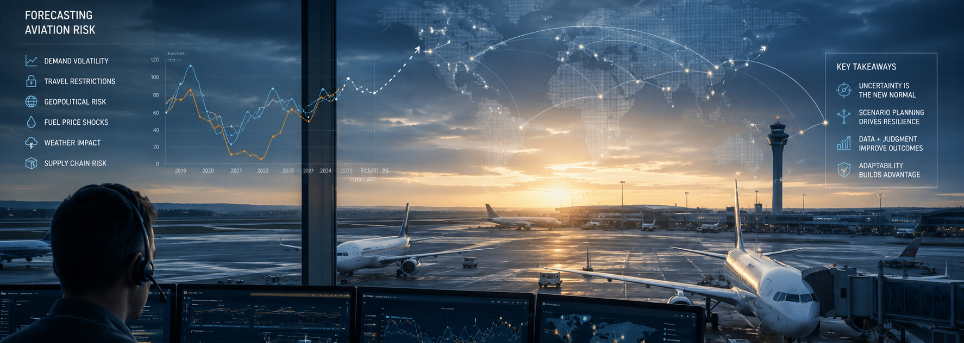
The aviation industry has always been exposed to external shocks. But if the COVID-19 pandemic taught us anything, it is this: the greatest risks are not always the most visible and traditional forecasting models are often least effective precisely when they are needed most.
As we navigate renewed geopolitical instability, particularly the ongoing conflict involving Iran and its impact on global fuel supply, those lessons feel more relevant than ever.
Then: Demand Collapse
Now: Supply Shock
During the pandemic, aviation faced an unprecedented demand crisis. Passenger numbers fell away almost overnight, and forecasting models, which are built on historical growth patterns, quickly became obsolete.
Today, the challenge is fundamentally different.
Rather than a lack of demand, the industry is facing a supply-side shock, driven by fuel availability, airspace disruption and geopolitical volatility. Jet fuel prices have surged dramatically, in some cases nearly doubling since the escalation of the Iran conflict, while supply chains remain fragile and highly exposed to disruption in key regions such as the Strait of Hormuz.
Airlines are responding with route changes, capacity adjustments and fare increases, but the underlying issue is deeper: uncertainty has shifted from passengers to infrastructure.
The Forecasting Fallacy
Pre-2020 forecasting models were largely built on three assumptions:
- Stable geopolitical conditions
- Predictable fuel pricing
- Gradual, linear demand growth
The pandemic dismantled the third. Current events are dismantling the first two.
Recent developments show just how quickly conditions can change. Airlines are already revising capacity forecasts and bracing for significantly higher fuel costs due to geopolitical instability. At the same time, concerns over fuel shortages, particularly in Europe and Asia, highlight the operational vulnerability of “just-in-time” fuel supply chains.
The lesson is clear: forecasting based solely on historical data is no longer sufficient.
From Prediction to Preparedness
What the pandemic, and now the jet fuel crisis, have demonstrated is the need to shift from forecasting certainty to planning for volatility.
For airports, this means:
- Scenario-Based Planning
Rather than relying on a single forecast, operators must model multiple scenarios, ranging from demand shocks to supply constraints, and understand their operational implications. - Supply Chain Visibility
Fuel resilience is emerging as a strategic priority. Airports must work more closely with fuel suppliers, governments and airlines to understand vulnerabilities and build contingencies. - Operational Flexibility
The ability to scale operations up or down quickly, whether due to demand collapse or fuel shortages, is now a core competency, not a contingency plan. - Cross-Sector Collaboration
The interconnected nature of aviation means risks rarely sit in isolation. Airspace closures, energy markets and geopolitical tensions are now tightly coupled variables.
A Structural Shift in Risk Thinking
One of the most important insights from recent months is that aviation risk is no longer cyclical, it is systemic.
The pandemic showed how quickly global demand can evaporate. The current fuel crisis shows how quickly supply can be constrained, even when demand remains strong.
In both cases, the speed and scale of disruption exceeded conventional planning assumptions.
Looking Ahead
The industry is not short of data. What it needs is a new mindset.
The reality we’re now seeing is that modelling is not a one-off exercise, but an ongoing process that evolves as new parameters emerge. Accordingly, modelling resources need to be agile and capable of responding quickly to change. The tools used must be equally flexible, enabling rapid adaptation as conditions shift.
Forecasting will always have a role but it must now sit alongside resilience planning, real-time monitoring and adaptive decision-making.
Feel free to get in touch if you’d like to explore this further.