

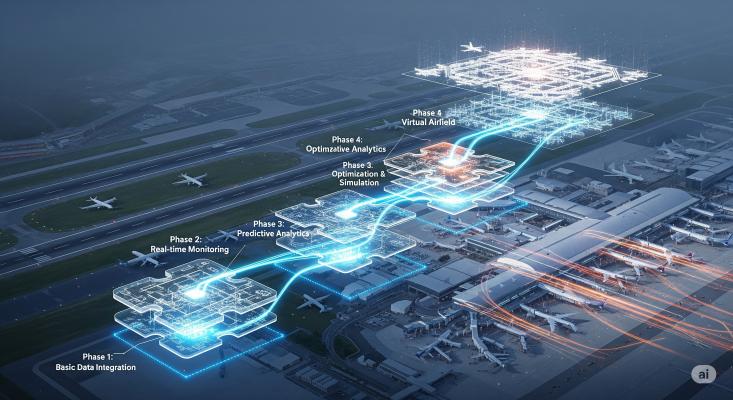
Artificial Intelligence (AI) has quickly become one of the most talked-about technologies across almost every industry, and aviation is no exception. While headlines often focus on futuristic concepts and fully autonomous airports, the reality is that AI is already beginning to influence airport planning in more practical and measurable ways.
For airport operators, planners and consultants, AI presents an opportunity to work smarter, analyse larger volumes of data and make better-informed decisions. However, the most successful applications are unlikely to replace human expertise. Instead, they will enhance it.
A Data-Driven Industry Ready for AI
Airport planning has always relied on data. Passenger forecasts, aircraft movements, terminal capacity, baggage performance, stand utilisation and operational metrics all play a vital role in planning for future growth.
The challenge is that airports are generating more data than ever before. Analysing it manually can be time-consuming and often limits how many scenarios can realistically be explored.
This is where AI can make a genuine difference.
Rather than replacing traditional planning methodologies, AI can help identify patterns, automate repetitive analysis and process large datasets far more efficiently than conventional techniques alone.
Supporting Better Forecasting
Forecasting has always involved balancing historical trends with future uncertainty.
AI has the potential to strengthen forecasting by analysing a wider range of influencing factors, including:
- Economic indicators
- Tourism demand
- Airline capacity changes
- Weather patterns
- Major events
- Historical passenger behaviour
Used appropriately, AI can help planners identify trends more quickly and test multiple growth scenarios in less time.
However, forecasts should never rely solely on AI-generated outputs. Airport planning requires an understanding of airline strategy, regulatory changes, infrastructure constraints and local market knowledge that only experienced professionals can provide.
Faster Scenario Modelling
One of AI’s greatest strengths is its ability to process multiple variables simultaneously.
Airport planners frequently need to answer questions such as:
- What happens if passenger numbers grow faster than expected?
- How will a new airline affect terminal capacity?
- Where will stand shortages occur first?
- How does a revised security process change passenger flow?
AI can help generate and evaluate numerous scenarios rapidly, allowing planners to focus more time on interpreting results and developing practical recommendations.
Rather than spending days preparing data, consultants can spend more time solving problems.
Improving Operational Planning
Beyond long-term master planning, AI is beginning to support day-to-day operational decision making.
Potential applications include:
- Predicting passenger peaks throughout the day
- Identifying congestion before it occurs
- Optimising gate and stand allocation
- Supporting baggage system performance analysis
- Improving resource planning across airport operations
Many of these applications build upon existing modelling techniques, using AI to improve speed, accuracy and responsiveness.
Enhancing Simulation and Digital Twins
Simulation modelling has long been an important tool within airport planning.
AI is beginning to enhance these models by enabling more dynamic simulations that continuously learn from operational data.
Combined with digital twin technology, airports may increasingly be able to test infrastructure changes, operational procedures or future demand scenarios in virtual environments before making real-world investments.
This allows decision-makers to explore options with greater confidence while reducing risk.
The Importance of Human Expertise
Despite the excitement surrounding AI, airport planning remains fundamentally about making informed decisions.
AI can analyse data.
It cannot replace decades of aviation experience, stakeholder engagement, regulatory understanding or commercial judgement.
Successful airport planning requires balancing competing priorities, understanding operational realities and translating technical analysis into practical strategies.
These are areas where experienced consultants continue to add significant value.
The best outcomes are achieved when AI supports expert judgement rather than attempting to replace it.
A Practical Future
As AI technology continues to mature, its role within airport planning is likely to grow steadily.
Routine analytical tasks may become more automated, enabling consultants to spend more time interpreting findings, engaging stakeholders and developing innovative solutions.
For airports, this means faster analysis, improved decision-making and greater confidence when planning for future growth.
The future is unlikely to be about AI replacing airport planners.
Instead, it will be about combining intelligent technology with experienced professionals to deliver better, more informed planning decisions.
How AiQ Is Responding
At AiQ, we see AI as another tool that can strengthen the planning process when applied responsibly and with the right expertise.
We continue to explore emerging technologies that can enhance data analysis, modelling and scenario planning, while remaining focused on what matters most: delivering practical, evidence-based advice that reflects the unique operational, commercial and strategic challenges faced by every airport.
Technology will continue to evolve, but successful airport planning will always depend on experienced people asking the right questions, interpreting the evidence and helping clients make confident decisions.
Please do get in touch with us if you’d like to explore any of these areas further.