

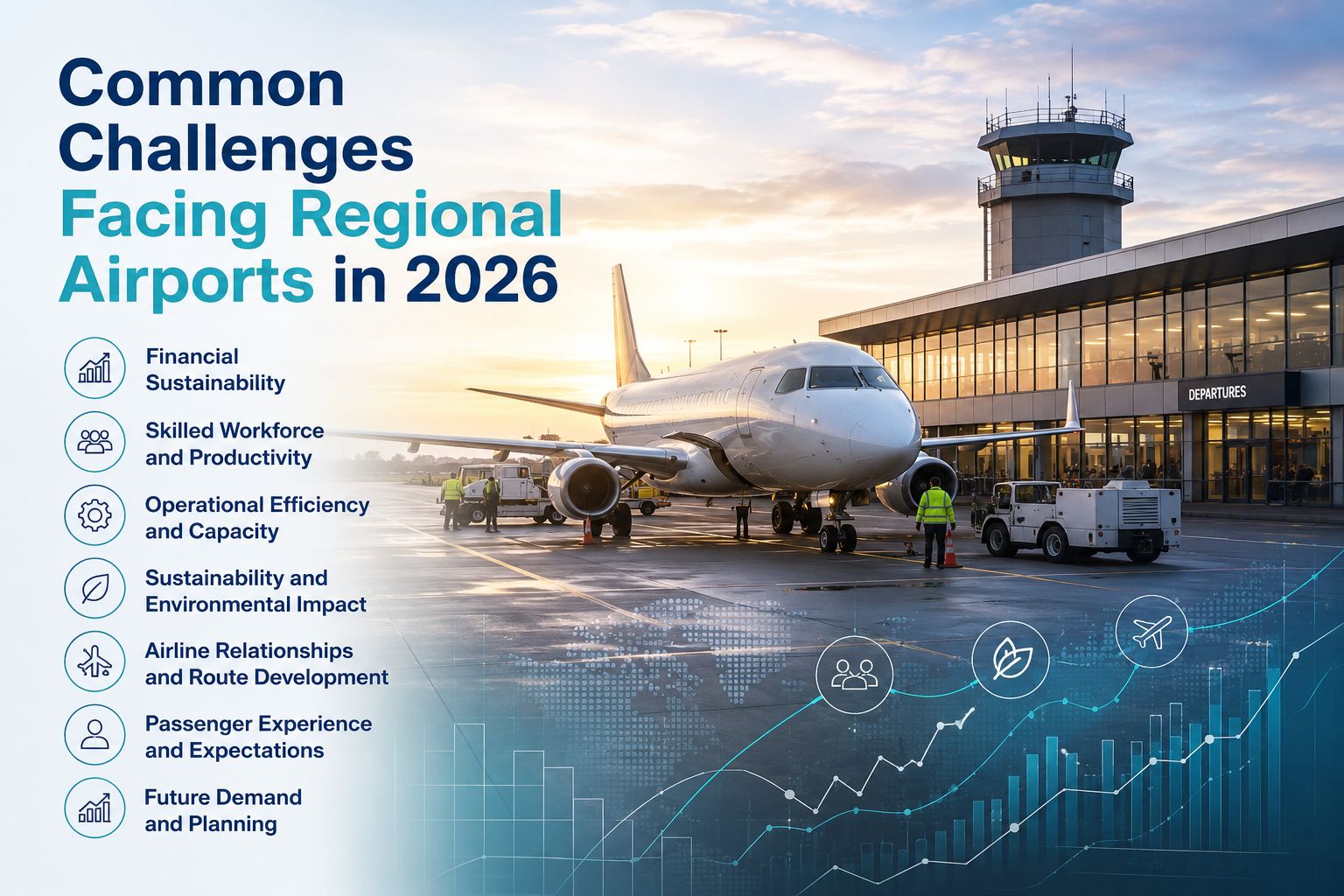
Regional airports continue to play a vital role in connecting communities, supporting economic growth and providing access to domestic and international markets. Yet in 2026, many face a complex mix of operational, financial and environmental challenges that require careful planning and strategic decision-making.
While passenger demand has remained resilient in many markets, regional airports are under increasing pressure to improve efficiency, manage limited resources and adapt to changing airline and passenger expectations. Success is no longer defined simply by accommodating growth; it depends on building resilient, flexible operations that can respond to uncertainty.
Balancing Growth with Financial Sustainability
Many regional airports operate within tighter financial constraints than larger international hubs. Capital investment must be carefully prioritised, particularly where passenger numbers fluctuate seasonally or airline schedules change frequently.
Airport operators are often faced with difficult decisions around infrastructure investment. Should they expand terminal facilities, improve airside operations or invest in digital technologies? The answer depends on understanding where operational bottlenecks exist and identifying improvements that deliver the greatest long-term value.
Detailed forecasting, scenario modelling and business case development are becoming increasingly important tools for ensuring investment decisions are evidence-based and aligned with future demand.
Recruiting and Retaining Skilled Staff
Staffing continues to be one of the biggest operational challenges across the aviation sector.
Regional airports often compete with larger airports and other industries for skilled employees, making recruitment and retention more difficult. Labour shortages can affect security operations, airside services, engineering, baggage handling and customer service.
Rather than simply increasing headcount, many airports are focusing on improving workforce productivity through better operational planning, clearer processes and greater use of technology to support staff.
Digital tools, operational dashboards and improved resource planning can help airport teams make better decisions while reducing pressure on frontline employees.
Improving Operational Efficiency Without Major Expansion
Unlike major international hubs, many regional airports have limited opportunities for large-scale infrastructure expansion.
Instead, attention is increasingly turning towards making better use of existing assets.
This includes improving stand allocation, reducing aircraft turnaround times, optimising passenger flows and enhancing collaboration between airport operators, airlines and ground handlers.
Data-driven operational planning allows airports to identify inefficiencies that may not be immediately visible and implement practical improvements without significant capital expenditure.
In many cases, relatively small operational changes can deliver measurable improvements in capacity, resilience and passenger experience.
Responding to Environmental Expectations
Sustainability continues to influence airport strategy across every area of operation.
Regional airports are working towards ambitious carbon reduction targets while balancing commercial realities and operational requirements. This involves reviewing energy use, supporting the transition to electric Ground Support Equipment, improving vehicle movements across the airfield and planning infrastructure that supports future sustainable aviation technologies.
Environmental considerations are also becoming increasingly important when securing funding, attracting airline investment and engaging with local communities.
Developing realistic decarbonisation roadmaps allows airports to make steady progress while maintaining operational performance.
Managing Airline Relationships
Airline networks continue to evolve rapidly in response to changing passenger demand, fleet availability and economic conditions.
For regional airports, maintaining strong relationships with existing carriers while attracting new routes remains a constant challenge.
Airports need robust data to demonstrate market demand, forecast route performance and support discussions with airlines considering future investment.
Understanding capacity constraints, operational performance and passenger behaviour helps create stronger business cases that benefit both airports and airline partners.
Enhancing the Passenger Experience
Passenger expectations continue to rise, regardless of airport size.
Travellers increasingly expect efficient security processes, intuitive wayfinding, reliable information and a seamless journey from arrival to departure.
Regional airports have an opportunity to differentiate themselves by delivering a more personal, less stressful experience than larger hubs.
Using operational data to understand passenger flow and identify congestion points enables airports to improve service levels while making better use of existing facilities.
Small improvements to layout, processing times and communication can have a significant impact on customer satisfaction.
Preparing for Future Demand
Perhaps the greatest challenge facing regional airports is planning for an uncertain future.
Passenger demand, airline strategies, regulation, technology and sustainability requirements continue to evolve, making long-term planning increasingly complex.
Rather than relying on fixed assumptions, many airports are adopting more flexible planning approaches that allow them to test multiple growth scenarios and adapt investment strategies as circumstances change.
This creates greater resilience while reducing the risk of over- or under-investing in infrastructure.
Supporting Regional Airports Through Strategic Consultancy
Addressing these challenges requires more than operational expertise. It demands a strategic understanding of airport operations, capacity planning, forecasting and long-term development.
By combining operational analysis with data-driven modelling, airports can identify opportunities to improve efficiency, enhance resilience and make informed investment decisions that support sustainable growth.
Whether reviewing terminal operations, forecasting future demand, assessing capacity or developing long-term masterplans, an experienced airport consultancy can help regional airports navigate today’s challenges while preparing confidently for tomorrow.
Please do get in touch with us if you’d like to explore any of these areas further.