

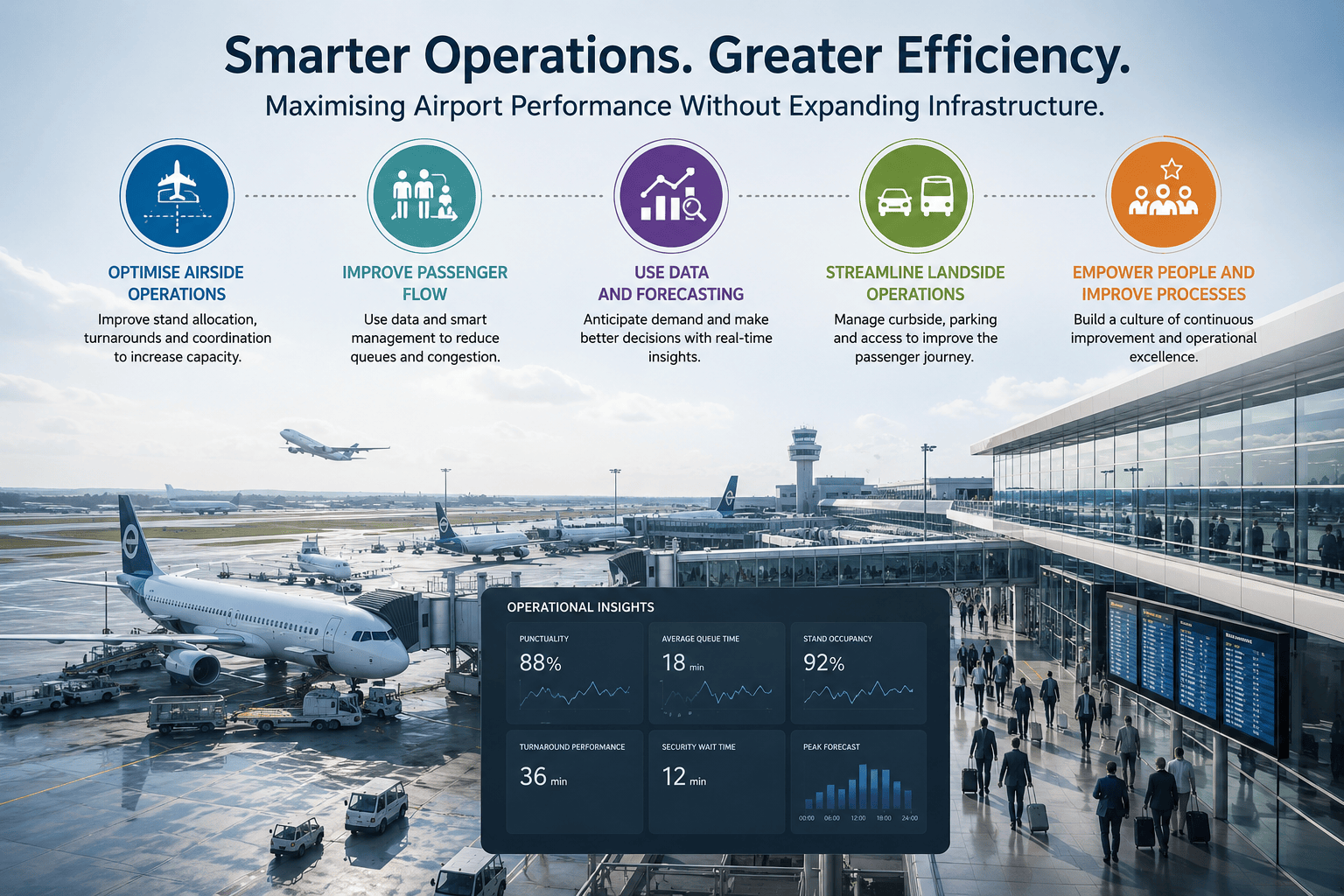
Airports worldwide are under pressure to handle growing passenger numbers, tighter turnaround times, and increasing expectations for a seamless travel experience. While expanding terminals, runways, or aprons can increase capacity, major infrastructure projects are expensive, time-consuming, and often constrained by land, planning and environmental limitations.
The good news is that many airports can unlock significant operational gains without building new facilities. By focusing on smarter processes, better use of existing assets and data-driven decision-making, airports can improve throughput, reduce delays and enhance passenger satisfaction.
Optimise Airside Operations

Aircraft movement on the airside is one of the biggest determinants of airport efficiency. Small improvements in stand allocation, taxi sequencing and turnaround coordination can have a major impact on capacity and punctuality.
Key actions include:
- Dynamic stand management – use real-time operational data to assign stands based on aircraft type, turnaround requirements and downstream departures. This reduces towing movements and shortens taxi times.
- Collaborative Decision Making (A-CDM) – strengthen coordination between airlines, ground handlers, ATC, and airport operations. Shared situational awareness helps minimise delays and improves runway and gate utilisation.
- Turnaround performance monitoring – track each stage of the turnaround process — fuelling, catering, baggage, boarding and pushback — to identify recurring bottlenecks and improve consistency.
Improve Passenger Flow Through Existing Terminals

Terminal congestion is often caused more by uneven passenger flow than by a lack of space. Better management of queues, circulation and processing points can increase throughput without adding square footage.
Practical measures include:
- Real-time queue management – use sensors and analytics to monitor wait times at check-in, security and immigration. Staff can then be redeployed dynamically to relieve pressure points.
- Digital passenger guidance – mobile apps, dynamic signage and automated notifications help passengers move efficiently through the terminal and reduce crowding in key areas.
- Flexible security operations – adjust lane allocation and staffing levels throughout the day based on forecast demand rather than fixed schedules.
These changes not only improve efficiency but also enhance the passenger experience by reducing uncertainty and wait times.
Make Better Use of Data and Forecasting

Operational efficiency depends on anticipating demand and responding proactively. Airports that integrate data from multiple sources can make faster, better-informed decisions.
Focus areas include:
- Demand forecasting – combine flight schedules, historical trends, weather data and airline information to predict passenger volumes and operational peaks more accurately.
- Resource planning – align staffing, equipment and facility availability with forecast demand to avoid both shortages and underutilisation.
- Performance dashboards – provide operational teams with live KPIs on punctuality, queue times, baggage delivery, stand occupancy and other critical metrics.
A data-driven approach enables airports to move from reactive problem-solving to proactive operational management.
Streamline Landside Operations

Efficiency improvements are not limited to airside and the terminal. Landside operations including access roads, parking and kerbside management have a direct impact on overall airport performance.
Effective strategies include:
- Smart parking systems – use occupancy sensors and digital guidance to reduce circulation time and improve parking utilisation.
- Kerbside traffic management – introduce time-based access controls, dedicated ride-share zones and better signage to reduce congestion at terminal forecourts.
- Integrated transport coordination – work closely with rail, bus, taxi and ride-share operators to smooth passenger arrivals and departures during peak periods.
Reducing landside congestion can significantly improve the passenger journey and operational resilience.
Invest in Process Improvement and Culture

Technology and data are important, but sustainable efficiency gains also depend on people and processes. Airports that embed continuous improvement into their operational culture often achieve the best long-term results.
Consider:
- Lean process reviews – regularly map and analyse operational workflows to remove unnecessary steps, duplication and delays.
- Cross-functional training – equip staff with broader operational understanding so teams can collaborate more effectively during disruptions and peak periods.
- Continuous improvement programmes – encourage frontline teams to identify inefficiencies and propose practical solutions, supported by clear performance measurement.
A culture of operational excellence helps airports adapt quickly to changing demand and operational challenges.
Conclusion
Major infrastructure expansion is not the only path to greater airport capacity and performance. By optimising airside operations, improving passenger flow, leveraging data, streamlining landside processes and fostering a culture of continuous improvement, airports can achieve meaningful efficiency gains within their existing footprint.
For airport operators facing growing demand and constrained capital budgets, these operational and strategic improvements offer a practical, scalable way to enhance capacity, resilience and passenger experience without waiting years for new infrastructure to come online.
Feel free to get in touch with us if you’d like to explore any of these areas further.