

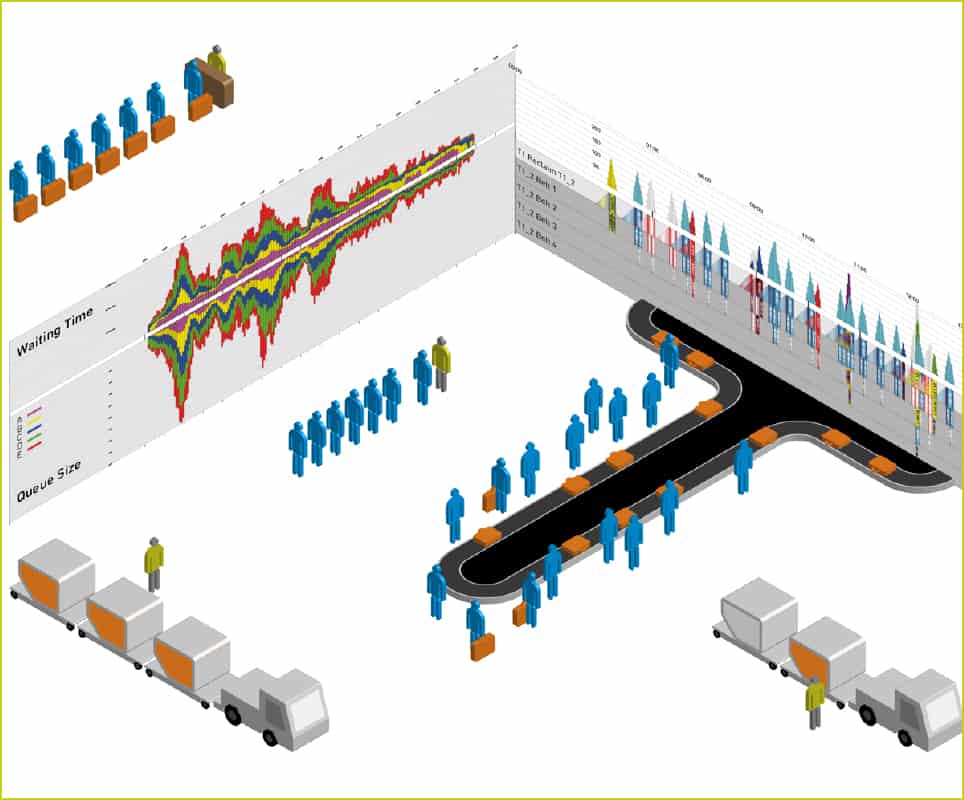
Airports operate in an environment where decisions can have long-term consequences.
Whether planning a terminal expansion, assessing future passenger demand, investing in new infrastructure or improving day-to-day operations, airport teams need to balance capacity, cost, service levels and uncertainty.
That is where modelling and analytics can make a real difference. Used effectively, data can help airports move beyond assumptions and provide a clearer evidence base for investment and operational planning.
Turning data into better decisions
Airports already generate and hold vast amounts of data — from passenger numbers and flight schedules to processing times, resource utilisation and operational performance.
The challenge is turning that information into something useful.
Modelling brings different data sources together to explore how an airport is likely to perform under different circumstances. Rather than looking only at what is happening today, it allows airport planners to test potential future scenarios and understand their implications.
Supporting investment decisions
Airport infrastructure represents significant investment, and decisions made today can affect operations for decades.
Data-led modelling can help establish whether an investment is required, what scale it needs to be and when it is likely to become necessary.
Demand forecasting, for example, can be used alongside capacity modelling to understand how passenger growth could affect terminals, stands, baggage systems, security, immigration, road access and other infrastructure.
Instead of planning simply around a single forecast, airports can assess multiple scenarios. A central forecast might be considered alongside higher- and lower-growth cases, allowing decision-makers to understand how robust a proposed investment is under different conditions.
This can help answer an important question:
Is the right investment being made at the right time?
Good modelling does not necessarily mean building more. It can also highlight opportunities to make better use of existing infrastructure, change operational processes or phase investment as demand develops.
Improving operational planning
Data and analytics are equally valuable for decisions that are closer to the day-to-day operation of an airport. Modelling can help identify where capacity is constrained and how changes in one part of the operation could affect another.
For example, an increase in passenger numbers may appear manageable at a terminal-wide level, but modelling could reveal pressure points at security, check-in, baggage reclaim, immigration or the departures lounge. Understanding these relationships gives airport teams the opportunity to address potential constraints before they become operational problems.
It can also support resource planning. By analysing passenger and flight profiles, airports can explore how staffing, equipment and facilities may need to change throughout the day or across different operating scenarios. The result is a more informed approach to planning resources around actual demand rather than relying solely on averages or historical patterns.
Testing the “what ifs”
One of the biggest advantages of modelling is the ability to test scenarios before making real-world changes.
Airport planning rarely happens in a predictable environment. Passenger demand changes, airline schedules evolve, infrastructure projects are delayed or brought forward, and operational assumptions can change.
Scenario modelling allows airport teams to ask “what if?” and understand the potential consequences.
For example:
What if passenger demand increases by 10%?
What if an airline changes its fleet mix?
What if a new route creates a different peak profile?
What if a terminal development is delayed?
What if passenger processing becomes more automated?
Exploring these scenarios can reveal where an airport has flexibility, where additional capacity may be required and which decisions are most sensitive to changing assumptions.
From forecasts to actionable insight
A forecast on its own is not a decision. The value comes from understanding what that forecast means for the airport.
This is where combining forecasting, modelling and analytics becomes particularly powerful.
A demand forecast might indicate that passenger numbers will grow over the next 10 or 15 years. Capacity modelling can then explore what that growth means for individual facilities and processes. Further analysis can identify potential interventions and compare different approaches.
This creates a chain from data to insight to action.
It also provides a stronger basis for communicating investment requirements to stakeholders, investors, airlines and other airport partners.
Making decisions with greater confidence
No model can predict the future with complete certainty. The purpose of modelling is not to produce a single definitive answer. It is to help decision-makers understand the range of possible outcomes and the factors that influence them.
That distinction is important. A good model should make assumptions clear, test their impact and allow users to explore alternative scenarios. It should also be grounded in a strong understanding of how an airport actually operates.
The most useful modelling therefore combines data, analytical techniques and aviation expertise.
Technology can process large volumes of information and identify patterns, but experienced airport planners are essential to interpreting those results and translating them into practical recommendations.
Better data, better questions, better decisions
For airports, the objective is not simply to collect more data. It is to use the right data to answer the right questions.
Whether assessing future capacity, planning infrastructure investment, evaluating operational changes or preparing for different demand scenarios, modelling and analytics can provide valuable evidence for better decision-making.
By taking a data-led approach, airports can make decisions that are more informed, more resilient and better aligned with their long-term objectives.
The best airport decisions are not based on data alone. They are based on using data to understand what could happen, and deciding what to do about it.
At AiQ Consulting, we combine airport planning expertise with modelling, forecasting and data analytics to help clients understand future demand, identify constraints and make informed decisions about capacity and investment. Please do get in touch with us if you’d like to explore any of these areas further.